

Breaking the Fourth Wall
What happens when fanfiction goes mainstream


Hi Friends! Welcome back to another issue of Romancing the Phone. This week, we’re returning to a treasured topic: fanfiction. My post about The Year of Dramione is my most read post ever. And just a little over a year on from that post, the fanfiction landscape and the fanfiction to publishing pipeline have both crossed over even more into the mainstream, thanks to the success of Alchemised and the popularity of Heated Rivalry, among (many) others. And with mainstreamification comes press coverage, some thoughtful and some not so thoughtful (as romance readers around Valentine’s Day are well aware of).
To complicate matters, fandom has always been resistant to outside attention, for reasons both legal and personal. After all, the existence of websites like AO3 relies on authors not profiting off the work of other creators. In both RPF (real person fiction) and other fan communities, sharing fic with the people involved or with the general public is called breaking the fourth wall - breaching the imaginary divide that exists between fan content and the original creator, and calling attention to its existence.
But as fanfiction becomes less a subculture and more the driver of the dominant culture, is the preservation of the fourth wall even possible? And if not, what does that mean for fandom moving forward?
Press Coverage

Three recent stories have really stood out to me in terms of fandom discourse and reckoning with the position of fandom in contemporary culture. First, Defector’s Eli Cugini wrote about Fanfiction’s Total Cultural Victory. This article makes some fascinating points, even as it maintains a level of skepticism toward mainstream romance and elevates so-called literary projects.
“This is a fanfiction pipeline—dabbling in speculative stories about characters for a group of equally enthusiastic friends, producing a manuscript fast and pleasurably—but Bradley avoids the term and avoids associating herself with fanfiction websites or any knowledge of fanfiction culture, instead keeping the story to a spontaneous literary game. Fanfiction is always treated as much less suspect if it's stumbled upon from first principles.”
I think it’s worth interrogating why this is!
I do appreciate the way this article unpacks the fact that, in a world where authors are self publishing and editors have less time for the projects they take on, fanfiction is a place where writers can learn valuable skills and get actual feedback and training in their craft.
Next, Teen Vogue published a guide on how to write and read RPF ethically that immediately blew up on twitter (mostly as a joke). While I’m not sure this guide answers its own question, I appreciate that it tackles some of the gender issues that are at the core of how fanfiction of all kinds is received.
Then, this week (glad I waited to write this one as it percolated in the back of my brain), Vulture’s Alex Jung wrote about the history of fujoshi fanfiction in the context of Heated Rivalry’s cultural takeover. This article was followed by a Vulture history of slash fiction entitled “The Horny Girls Who Walked So Heated Rivalry Could Run.”


These pieces were not greeted with enthusiasm by many fans. Among the criticisms: why are these types of pieces about fandom culture almost always written by male outsiders? And why is it so socially acceptable to call the response to Heated Rivalry a mass psychosis event? Is that just another way of saying female hysteria?


Some of these responses represent, to a certain extent, a lack of understanding of how mainstream journalism works. Jung is a culture writer at vulture - covering the culture as an objective observer is his job. But there are real issues to unpack here, among them: what does it mean when women are reading and writing about queer male relationships?

Jung’s piece is very thoroughly researched, even if some amount of nuance is missed.
““What I wanted to write about specifically was homophobia and toxic masculinity, and hockey’s a good arena.” This is all valid and admirable, but why eight — soon to be nine — gay hockey romances with such detailed, breathlessly written sex scenes? “I don’t know. I wanted to write a joyful queer love story, I guess,” she says. “I should get these thoughts hammered out. I’m between therapists.”
In particular, I think it fails to understand the pleasures of a romance novel.
One of the fandom’s chief objections to this piece? Including links to fanfiction, a practice that explicitly breaks the fourth wall. But are journalists subject to those kind of unwritten group rules? And if creators don’t want their fanfiction to be public, should they lock their AO3 accounts?
New Fans and Fandom Gatekeeping


All of this leads me to the other phenomenon I’ve been seeing in online fan spaces lately: gatekeeping, particularly of access to AO3. This kind of fan behavior isn’t new, nor is it surprising, but I’ve certainly seen a rise in this opinion recently. And in light of all this fandom coverage, it does make a certain amount of sense. There is a desire to close ranks and prevent outsider gawking at a subculture that is clearly not quite understood by the mainstream, even as (and perhaps because) reading and writing fanfiction is as mainstream as it has ever been. See below: you can load AO3 on a graphing calculator! This would have been very valuable information for me in my high school calculus class:

 Tiktok failed to load.
Enable 3rd party cookies or use another browser
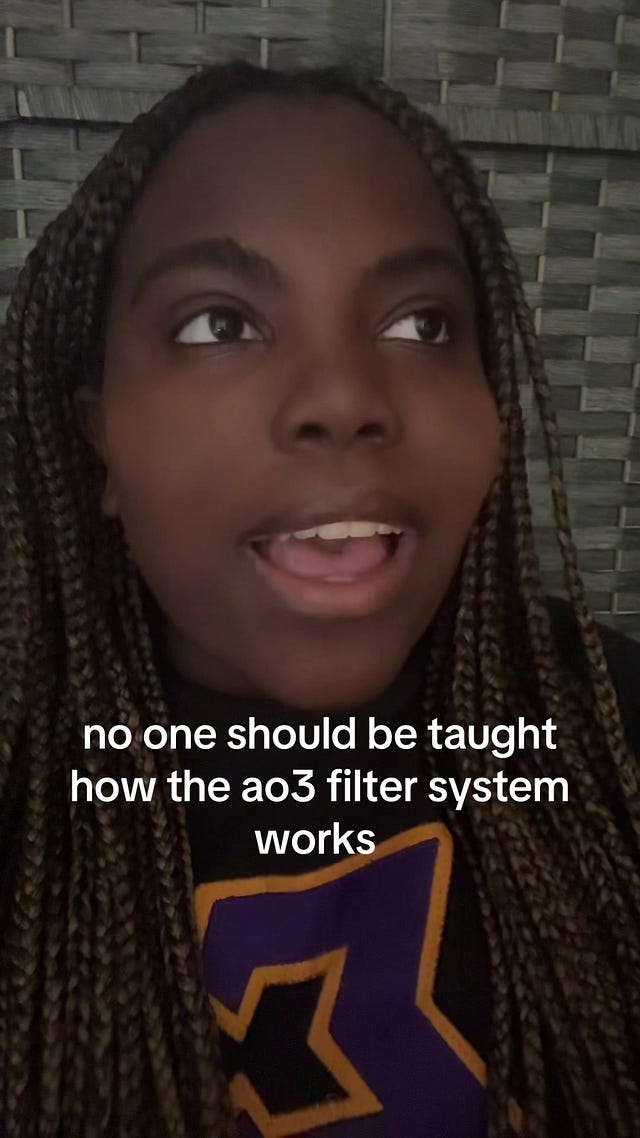
But scattered amongst these jokes and celebrations of the platform are serious and semi-serious attempts to keep new fans away.
 Tiktok failed to load.
Enable 3rd party cookies or use another browser

Translation: The worst part about AO3 getting more popular is that it’s ending up in the hands of people who don’t know how to use tags on their own fics and can’t tell the difference between “&” and “/”
Another interesting trend I’m seeing, and one that is probably worthy of a much longer and more in depth article by someone with a PhD in gender studies: the rise in prevalence of the term hetslop when referring to fanfiction written about straight couples, in both serious and self-deprecating ways. It seems that there is no correct way to write about romantic relationships.


So —Are we at a tipping point, where fans will try to lock down fandom spaces? Is it just that the pandemic invited in a lot of new fans and fanfic readers who were never schooled on fandom etiquette? By going mainstream, does fanfiction lose some of the things that make it countercultural? We shall see. It isn’t as though this is the first time fans have been outraged that a publication has linked to fanfiction - that has been happening for decades. And every time actors are asked to read fanfiction of their characters for some kind of Buzzfeed content, the outrage cycle begins anew. Every time, it has survived just fine.
What isn’t going away, at least for now, is the fanfiction to traditional publishing pipeline. Post-Heated Rivalry, the prevalence of M/M stories on fanfiction websites will be yet another place publishers seek to pull from to replicate its success.
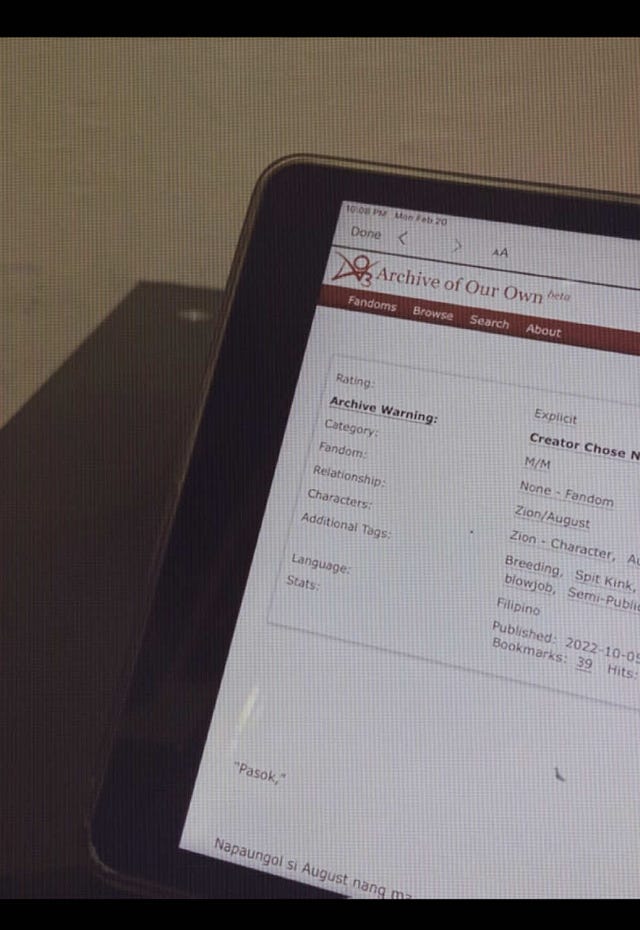
This TikTok made me laugh:
 Tiktok failed to load.
Enable 3rd party cookies or use another browser
To be continued next week, in a deep dive on the state of the fanfiction to traditional publishing pipeline in 2026, including popular fandoms, tropes, tags, and upcoming releases (will Dramione ever die? apparently not).
xoxo
I’d bet mainstream stranger things fanfics are just around the corner
Idk if I'd call Jung's piece thoroughly researched, it had some baffling factual errors like calling yuri on ice an adaptation of a manga when it was not